Showing posts with label Biomimicry. Show all posts
Showing posts with label Biomimicry. Show all posts
Thursday, September 27, 2012


Monday, July 9, 2012
101: Hospital Architecture: Building as City
101: Hospital Architecture: Building as City via YouTube
This video describes some interesting concepts and solutions to hospital planning issues derived from studies and principles of urban growth. Good to review whenever faced with a project (or site) that expects multiple future additions to follow the original.
From the description on YouTube:
This webinar introduces participants to fundamental issues in the planning and design of hospitals and medical centers including industry drivers for design, key planning and design considerations, basic hospital planning strategies and terms. It outlines and builds parallels between sound urban design principles and hospital planning and design. It also covers basic hospital building form types and organizational concepts.


Sunday, March 25, 2012


Sunday, November 20, 2011
StoCoat Lotusan
StoCorp picked up on the cleaning-power of a lotus—a plant with a unique hydrophobic microstructure that forces water droplets to bead and roll off its leaves—to improve the lifespan of numerous hard-to-clean materials such as stucco, concrete and other exterior wall finishes. The company’s Solit Lotusan exterior coating paint, with its patented “Lotus Effect” has super-hydrophobic properties and miniscule peaks and valleys on the its surface, making it highly resistant to water, dirt, mold, mildew, chalk and even UV rays. Stolit Lotusan paint can help surfaces stay dry and clean, and could help decrease maintenance cleaning and water costs for building owners.
The StoCorp’s “Lotus Effect” coating, coined by botanist Dr. Wilhelm Barthlott, was introduced into the European market in 1999 and has now been applied to more than 300 million square feet of façade surfaces. Available in more than 38 colors and custom tints, Stolit Lotusan can be used to coat over prepared vertical concrete, masonry or plaster substrates. More info: www.stocorp.com
The StoCorp’s “Lotus Effect” coating, coined by botanist Dr. Wilhelm Barthlott, was introduced into the European market in 1999 and has now been applied to more than 300 million square feet of façade surfaces. Available in more than 38 colors and custom tints, Stolit Lotusan can be used to coat over prepared vertical concrete, masonry or plaster substrates. More info: www.stocorp.com
Dyesol solar cells
Dye Solar Cell
Using a dye similar to the chlorophyll found in green leaves, the Dye Solar Cell (DSC) prototype by Dyesol departs from the more traditional silicon-based solar cells by working to mimic the photosynthetic processes of plants. Dyesol’s technology creates an artificial photosynthetic process by inducing a charge between a titanium dioxide semiconductor and an electrolyte solution. Then it builds the technology into small tiles that compose panels, which can be installed anywhere that might accommodate the conventional photovoltaic panels. Dyesol argues that the DSC is a sustainable answer to the commonly used silicon-based solar cells, which require large amounts of energy to produce.
The Australia-based company has a working prototype and is aiming to license its technology. It reported in June 2009 that it received an order for more than $788,500 of Dye Solar Cells to a subsidiary of Malaysia-based Petronas, a Fortune Global 500 company. Dyesol also sells the photosynthetic dyes and other components on its Web site. More info: www.dyesol.com

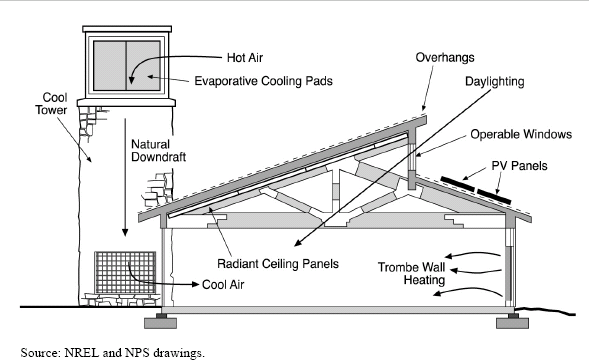
Trombe wall / solar chimney / passive heating

via Wikipedia - Common modifications to the Trombe wall include:
- Exhaust vent near the top that is opened to vent to the outside during the summer. Such venting makes the Trombe wall act as a solar chimney pumping fresh air through the house during the day, even if there is no breeze.
- Windows in the trombe wall. This lowers the efficiency but may be done for natural lighting or aesthetic reasons. If the outer glazing has high ultraviolet transmittance, and the window in the trombe wall is normal glass, this allows efficient use of the ultraviolet light for heating. At the same time, it protects people and furnishings from ultraviolet radiation more than do windows with high ultraviolet transmittance.
- Electric blowers controlled by thermostats, to improve air and heat flow.
- Fixed or movable shades, which can reduce night-time heat losses.
- Trellises to shade the solar collector during summer months.
- Insulating covering used at night on the glazing surface.
- Tubes or water tanks as part of a solar hot water system.
- Fish tanks as thermal mass.
- Using a selective surface to increase the absorption of solar radiation by the thermal mass.
- Also: Barra System
Panelite ClearShade Insulating Glass Unit
Just as the hub of a bee hive is the honeycomb, the hub of New York-based Panelite’s ClearShade insulating glass unit is its “tubular polycarbonate” core. Modeled after the hexagonal structure of a honeycomb, ClearShade’s core limits sunlight coming through glass thereby reducing heat gains as well as energy costs. Because light rays can only make it through when they hit the glass perpendicularly, the sun is most obscured when it is highest in the sky. At midday, ClearShade has a low shading coeffcient and a low solar heat gain coefficient—which Panelite touts as “four times better than a typical insulating glass unit.”
 The honeycombed glass glaze was first used in the entryway of the McCormick Tribune Campus Center at the Illinois Institute of Technology, and was last year installed in the new JetBlue terminal at JFK International Airport. The ClearShade insulating glass unit can be glazed different colors, and its unique structure can give logos or patterns a three-dimensional effect.
More info:
www.e-panelite.com
IGU Catalogue.pdf
Bonded Catalogue.pdf
More info:
www.e-panelite.com
IGU Catalogue.pdf
Bonded Catalogue.pdf
Eastgate Centre, Harare - Mick Pearce
The "termite mound building".
Eastgate Centre, Harare - Wikipedia, the free encyclopedia

Eastgate Centre, Harare - Wikipedia, the free encyclopedia
http://inhabitat.com/building-modelled-on-termites-eastgate-centre-in-zimbabwe/
Because of its altitude, Harare has a temperate climate despite being in the tropics, and the typical daily temperature swing is 10 or 40 °C. This makes a mechanical or passive cooling system a viable alternative to artificial air-conditioning.
Because of its altitude, Harare has a temperate climate despite being in the tropics, and the typical daily temperature swing is 10 or 40 °C. This makes a mechanical or passive cooling system a viable alternative to artificial air-conditioning.
Tuesday, August 23, 2011
13-Year-Old Makes Solar Power Breakthrough by Harnessing the Fibonacci Sequence
from Inhabitat:
13-Year-Old Makes Solar Power Breakthrough by Harnessing the Fibonacci Sequence
While hiking through the Catskills, seventh grader Aidan Dwyer was not snapping and throwing tree branches but studying their tangled pattern high about his head. He came up with a theory for the way that tree branches grow based on the Fibonnacci sequence and tested it by building a miniature solar energy generating tree that produces 20% - 50% more power than a flat solar array.
Aidan measured the angles at which branches spread out from trees using a home-made tool made of a plastic tube and two protractors. He then built a test model of an oak tree’s Fibinacci pattern using tiny solar panels instead of leaves. He set it outside next to flat solar panel and collected data for three months — and the results were incredible.
The solar tree made 20% more electricity and collected 2 and a half more hours of sunlight than the flat panel. Even more exciting, when tested in December, the darkest, shortest days of the year, the tree panel performed even better, producing 50% more electricity than the flat panel and collecting 50% more sunlight.
Subscribe to:
Posts (Atom)