Showing posts with label Div 22 Plumbing. Show all posts

Monday, January 27, 2014

BUSSE Green Technologies Inc.

BUSSE Green Technologies Inc.:
Total off-grid water treatment.  Sewage goes in, potable water comes out.
Available in all sizes, even small enough for single-family residential applications.
Yeah, it's German.
http://www.thisoldhouse.com/toh/tv/house-project/overview/0,,20587082,00.html
Waste Water Recycling
The Busse MBR technology reliably ensures the cleaning and disinfection of domestic waste water by a stable biological
process and the membrane barrier. Due to this the waste water is made fit for use as re-use water.
The operating costs of the plant are only a fraction of the costs for drinking water and the charges for waste water.
Therefore recycling is an ecological alternative – especially as the re-use water can be used for watering the garden
or flushing toilets. With additional modules it can also be used for washing machines or to fill up pools, etc.

Sunday, November 11, 2012

Corrosion of copper piping passing thru walls


   From: [REDACTED]
   Sent: [REDACTED]
   To: [REDACTED]
   Subject: Corrosion of copper piping passing thru walls

   It has come to our attention on several hospital projects, that the use of USG Sheetrock Acoustical Sealant has been specified for closure around piping penetrations at drywall partitions. This product is causing corrosion on non-insulated copper pipe. It is strongly suggested architectural specifications for this product be reviewed to include products that do not cause this corrosion. The following italics are from a contractor friend's email concerning the issue they are dealing with on a project of theirs.
   
   Because of possible litigation, they asked that I not identify them.
   
   In summary, at every rated wall assembly (smoke and fire) where medical gas copper piping passes through the wall and is sealed using USG Sheetrock Acoustical Sealant, the copper pipe is corroding.  There are three types of corrosion of which two are harmless to the integrity of the pipe.  Unfortunately the third, formicary corrosion, is highly detrimental to the integrity of the pipe.  Our pipe has all three types at each location.  This condition was visually observed two months ago and a sample assembly was sent for further analysis and testing.  Scanning Electron Microscopy and Energy Dispersive X-Ray Spectroscopy Analysis were used for the tests.  The test results were received yesterday and they are not good.  In some instances the pipe already has 5 MIL deep pits in them and will only get worse as long as moisture and air are present.  Since we don’t live on the moon, humidity and air are very much present.  We are likely facing a situation that will require us to replace all exposed copper pipe penetration locations.  Thus far it is limited to exposed copper (medical gas system) and a preliminary survey indicates this would be approximately 2,000 locations.   Insulated copper pipe (water system) is perfectly fine.
   
   I have also attached a picture of some of the piping that was removed for testing.  Looking at the pipe in the picture, areas where the sealant is on the pipe and the pipe has begun to turn blue is corrosion.
   
   They have elected to utilize HILTI 506 rather than the USG product. Needless to say the proper sealant should be utilized for the rated wall assembly that applies.
   
   Here's a link to the Hilti website.
   
   http://www.us.hilti.com/holus/page/module/techlib/teli_productreldocs.jsf?lang=en&selProdOid=566234&nodeId=-114925
   
   
  [REDACTED]
   

Thursday, September 27, 2012

Modern Pre-Fab Outdoor Showers | Oborain

Modern Pre-Fab Outdoor Showers | Oborain
solo 460x380

Siphonic Roof Drains


Advantages:

  • no slope required.  uses suction instead of gravity
  • full-bore flow.  no need to account for air in system = smaller pipes
Disadvantages:
  • still need to consider overflow drains or scuppers
  • all drains must be at same elevation to work together siphonically
see JR Smith, others.

Rainwater Harvesting Primer

see JR Smith presentation on Rainwater Harvesting:  http://www.jrsmith.com/education/presentations

Uses (non-potable)*:
  1. toilet flushing
  2. HVAC cooling
  3. irrigation
Do:
  1. Pretank filtration - centrifugal
  2. avoid disturbing sediment and bio filter at b/o tank - take water from just below surface
  3. provide overflow outlet equal to inlet
  4. see local codes for color of piping (purple), filtration requirements for toilet water, dyes, etc.
  5. wait 1 yr before using water run off from new asphalt shingle roofs
Filters:
  1. ask about maintenance.  high efficiency, low maintenance is most important
  2. size is based on sf of runoff area.  rule of thumb:  1" on 1,000 sf = 620 gallons
  3. keeps debris and food for bacteria out of tank
  4. if additionally required, UV and carbon filters are recommended over more expensive ozonators
Tank:
  1. indoor above grade - polyethylene recommended.  steel tanks come modular to get into small spaces
  2. outdoor below grade - fiberglass recommended.  steel is not recommended below grade.
  3. avoid running municipal water into tank. kills good bacteria.  when dry, use day tank or separate supply.
  4. tank should be opaque to inhibit algae growth
  5. below grade tanks will have lower, more consistent temperature, which is good for the right bacteria.
*note: rainwater is naturally soft.  no softeners are required.

Thursday, August 25, 2011

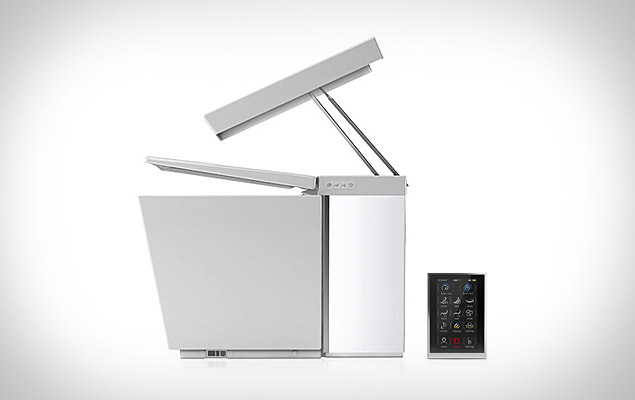
Kohler Numi Toilet

...motion-activated lid and seat, an integrated, retracting bidet, an integrated air dryer, a built-in air deodorizer, a heated seat, floor-level vents to keep both the floor and your feet warm...